


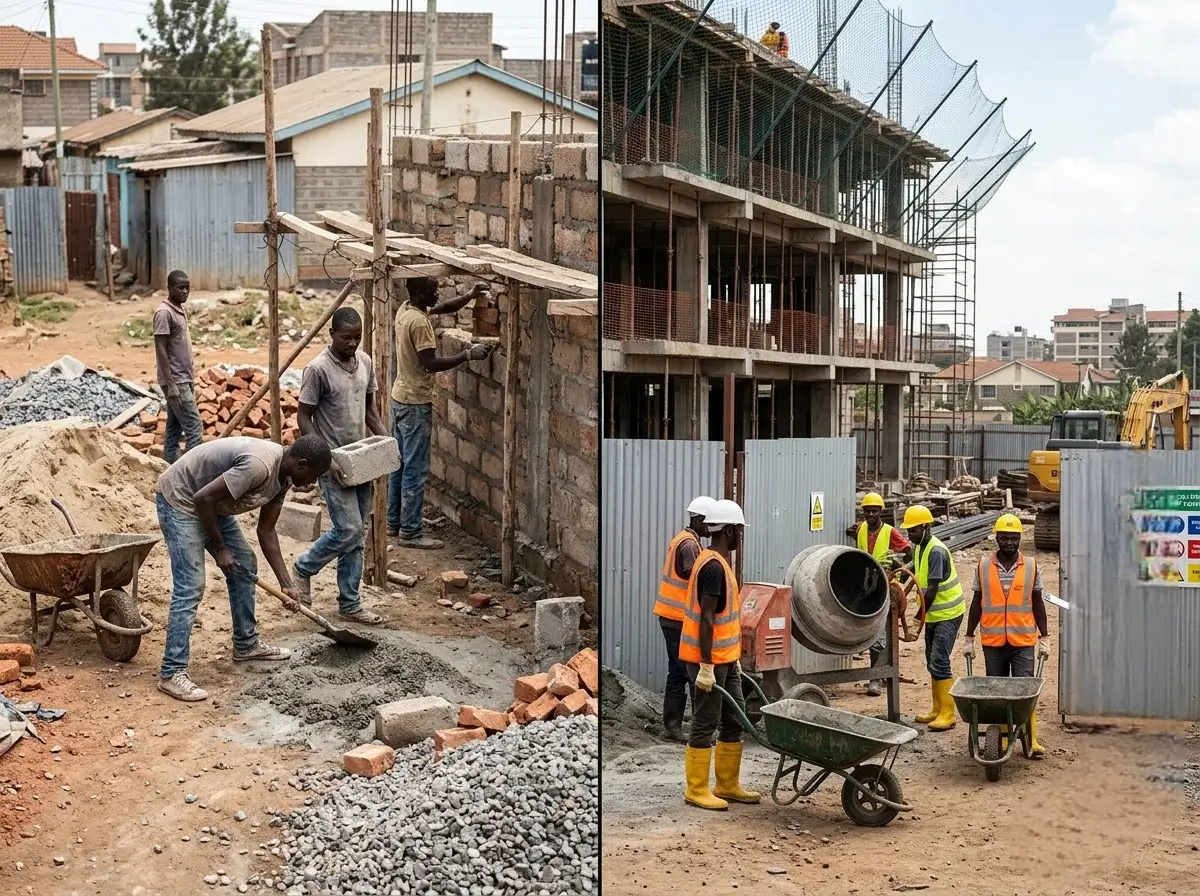
A lot of construction and renovation work in Kenya happens through informal fundis — individual tradespeople or small, unregistered crews, often hired through word of mouth, usually cheaper upfront than a formally registered firm. It’s a genuinely common choice, and for small, low-risk jobs it can work out fine. For anything bigger, it’s worth being honest about exactly what you’re trading off, rather than assuming cheaper always means equivalent. That’s the comparison to make before you choose between construction contractors in Kenya and an informal crew.
What Actually Differs
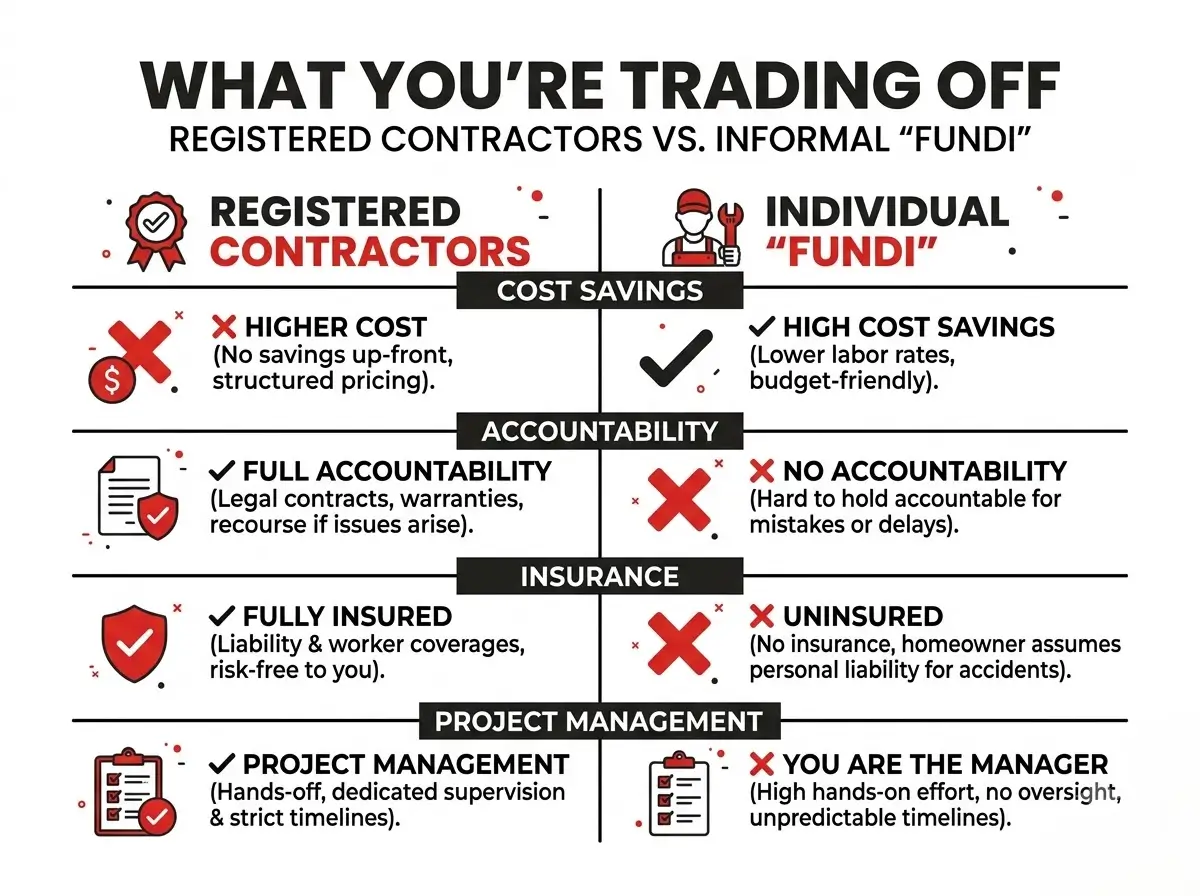
| Consideration | Informal Fundi | Registered Construction Contractor |
|---|---|---|
| Legal registration | Typically none | Registered with the National Construction Authority (NCA) |
| Accountability if something goes wrong | Limited — often no formal recourse | Clearer accountability, tied to a registered business |
| Insurance coverage | Rarely present | More likely to carry proper insurance |
| Project management | Usually handled informally, job by job | Structured planning, often including design and build services |
| Upfront cost | Generally lower | Generally higher, reflecting formal overhead and compliance |
| Suitable project scale | Small, low-complexity jobs | Mid-to-large projects, anything involving structural work or compliance requirements |
Why NCA Registration Actually Matters
Kenya’s construction sector is regulated by the National Construction Authority, which classifies contractors into categories based on the scale of project they’re authorised to handle. A firm registered under NCA Category 2, for example, has met requirements tied to a specific project scale — a baseline an informal fundi, by definition, hasn’t gone through. That doesn’t automatically mean every registered firm does better work than every fundi, but it does mean there’s a verifiable standard behind the former that simply doesn’t exist with the latter.
Where the Price Difference Actually Comes From
The lower cost of hiring a fundi isn’t arbitrary — it reflects the absence of registration overhead, formal insurance, structured project management, and often a smaller crew without the backup resources a registered firm maintains. For a small, contained job — a boundary wall, a minor repair — that trade-off might be entirely reasonable. For a project involving structural work, significant investment, or compliance requirements, the same trade-off carries meaningfully more risk.
What Happens When Something Goes Wrong
This is the part that genuinely separates the two options in practice. If a registered contractor’s work has an issue, there’s a formal business to hold accountable, and typically insurance to cover damages. If an informal fundi’s work has an issue — and informal work does carry real risk, given the lack of structured oversight — recourse is often limited to whatever goodwill or personal relationship exists, which isn’t much of a safety net for a significant financial commitment.
A Reasonable Way to Think About the Decision
The honest framework isn’t “registered firms are always right, fundis are always wrong” — it’s matching the formality of the contractor to the scale and risk of the project:
- Small, low-risk jobs (minor repairs, small fixtures) — an experienced, well-reviewed fundi can be a reasonable, cost-effective choice.
- Structural work, full renovations, new builds — the accountability, insurance, and compliance understanding of a registered contractor genuinely matter here, given the financial and safety stakes involved.
- Commercial or compliance-sensitive projects (banking, hospitality, retail) — registration and formal project management move from “nice to have” to effectively necessary.
Questions Worth Asking Before Deciding
- What’s the actual scale and complexity of my project — does it involve structural work or just surface-level repairs?
- If something goes wrong, what recourse do I realistically have with each option?
- Does my project have compliance requirements (commercial use, specific sectors) that require a registered firm?
- Am I comfortable with the risk profile of the cheaper option for this specific job?
FAQ: Registered Contractors vs. Informal Fundis
Is it ever reasonable to hire an informal fundi instead of a registered contractor?
Yes — for small, low-risk jobs like minor repairs, an experienced fundi can be a cost-effective, reasonable choice. The risk profile changes significantly for structural or large-scale work.
What does NCA registration actually verify?
It confirms a contractor has met requirements tied to a specific project scale category, giving clients a verifiable baseline that informal fundis, by definition, haven’t gone through.
Do registered contractors always carry insurance?
Not automatically, but it’s worth confirming directly — insurance coverage is far more likely with a registered firm than with an informal fundi, and it’s a reasonable question to ask before hiring either.
Why is accountability different between the two options?
A registered contractor is tied to a formal business that can be held accountable if issues arise. An informal fundi typically offers limited formal recourse if something goes wrong.
Is R World Enterprise Ltd. a registered construction contractor?
Yes — R World is registered with the National Construction Authority under NCA Category 2, reflecting formal accreditation for mid-to-large project work.
The Short Version
Choosing between an informal fundi and a registered construction contractor in Kenya comes down to matching the formality of the hire to the scale and risk of the project — small, low-stakes jobs can reasonably go either way, but structural work, large investments, and compliance-sensitive projects genuinely benefit from the accountability and registration a formal contractor provides.
Discuss your project with registered contractor R World Enterprise Ltd. or view the project portfolio for completed work.
Not sure whether your project needs a registered contractor?
Talk it through with us before you decide.
Contact Us