


Every firm claiming to be among the best interior designers in Kenya has a polished portfolio — that’s not a useful differentiator anymore, it’s just the baseline. A portfolio shows you what a firm can produce under ideal conditions, with their best work curated and presented. It doesn’t tell you how they’ll handle your actual project, your actual budget, or your actual timeline. Here’s what to compare beyond the pretty pictures.
What a Portfolio Actually Tells You (and What It Doesn’t)
| What a Portfolio Shows | What It Doesn’t Show |
|---|---|
| Aesthetic range and style capability | How the firm communicates during a project |
| Completed, successful projects | Projects that didn’t go smoothly, or how issues were handled |
| Curated best work | Average or typical project experience |
| Visual quality | Formal credentials — registration, certification |
| Scale of past projects | Whether they’re the right fit for your specific sector or budget |

Credentials Worth Checking Alongside the Portfolio
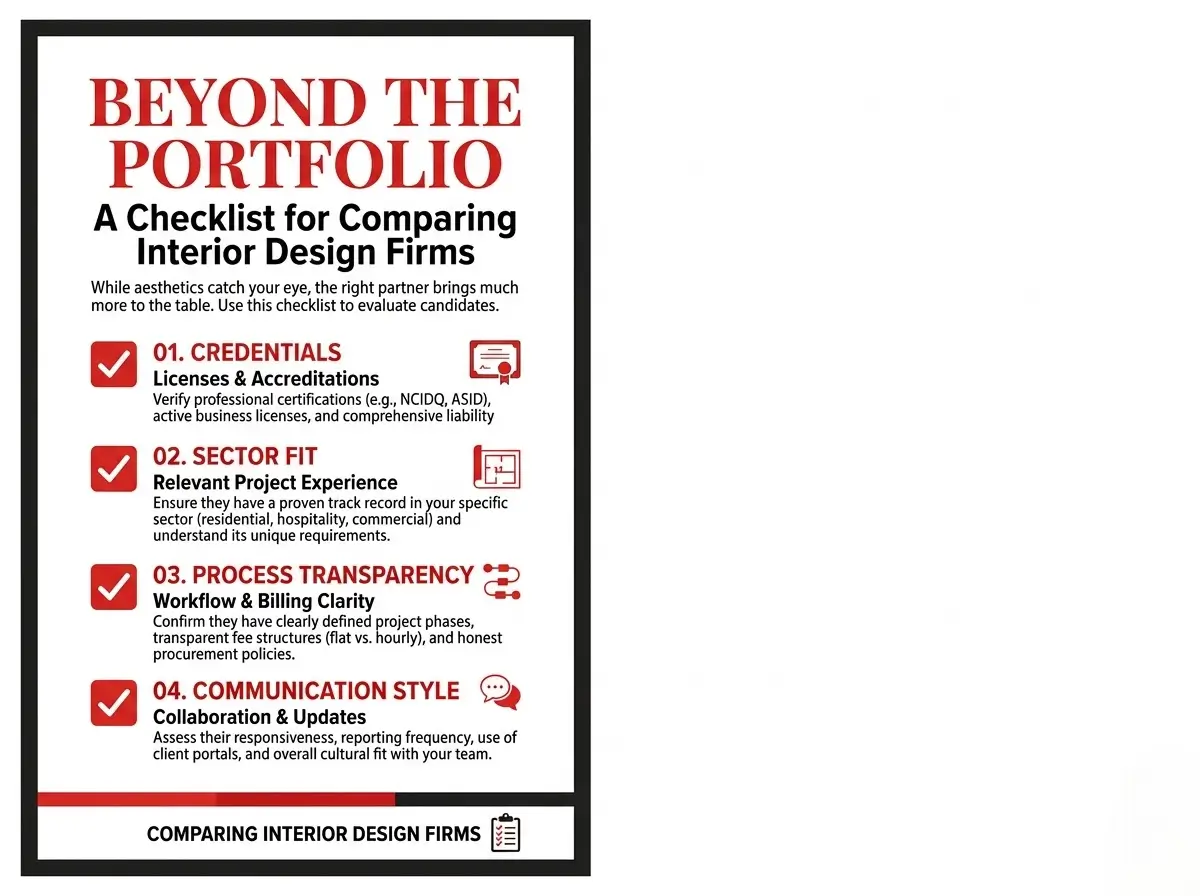
Formal accreditation gives you something a portfolio alone can’t: a verifiable, external standard rather than just curated visuals. Worth checking directly:
- ISO certification — reflects structured quality management processes across projects, not just showcase work
- Sector experience — has the firm actually worked in your specific area (residential, banking, hospitality, retail, corporate), or only adjacent ones?
- Range of completed work — a firm like R World Enterprise Ltd., with projects spanning Carrefour Rongai, Aga Khan Hospital, Skyrise, Jaguar, and Treewall Apartments, demonstrates range across sectors rather than a single specialism dressed up as versatility
Why Sector Fit Matters More Than Overall Reputation
A firm can be genuinely excellent at residential design and still be the wrong choice for a hospitality project, simply because the two involve different priorities, materials, and compliance considerations. When comparing firms, it’s worth asking specifically about experience in your sector rather than relying on general reputation alone — “best interior designers in Kenya” as a search phrase covers a very wide range of project types, and the best fit for your specific need isn’t necessarily the most broadly famous name.
Process Transparency as a Genuine Differentiator
A firm willing to explain their actual design process — how they approach space planning, what their typical timeline looks like, how they handle material selection — is giving you something more useful than a portfolio tour. The seven layers of interior design (space planning through to accessories) is the kind of structured process worth asking any firm to walk you through specifically for your project, rather than accepting a vague assurance that “we’ll handle everything.”
Questions That Actually Help You Compare
- Can you walk me through your design process for a project like mine, not just show me finished examples?
- What sector-specific experience do you have relevant to my project type?
- Are you ISO certified, or working to any documented quality standard?
- Can I speak to a past client in a similar project category to mine?
- What happens if my needs or budget change partway through the project?
Why the “Best” Label Shouldn’t Be the Deciding Factor on Its Own
Plenty of firms use “best” in their own marketing — it’s a near-universal claim in this industry, which makes it almost meaningless as a standalone filter. What actually separates firms worth genuinely considering is the combination of verifiable credentials, relevant sector experience, and process transparency — the things a portfolio alone, however impressive, doesn’t reveal.
FAQ: Comparing Interior Design Firms in Kenya
Is a firm’s portfolio enough to judge whether they’re right for my project?
Not on its own — a portfolio shows curated best work, but credentials, sector experience, and process transparency give a fuller, more reliable picture.
Why does sector-specific experience matter more than overall reputation?
Different sectors (residential, retail, hospitality, corporate) involve different priorities and requirements — a firm excellent in one sector isn’t automatically the right fit for another.
What credentials are actually worth checking?
ISO certification (process and quality standards) and, for firms also handling construction, registration with the National Construction Authority are both verifiable, external standards worth confirming.
Should I ask to speak with past clients?
It’s a reasonable request, particularly for clients in a similar project category to yours — it gives insight a portfolio and marketing materials won’t provide.
Does R World Enterprise Ltd. have range across multiple sectors?
Yes — completed projects span residential (Treewall Apartments), retail (Carrefour Rongai), healthcare-adjacent commercial (Aga Khan Hospital), and corporate offices (Skyrise, Jaguar).
The Short Version
Comparing the best interior designers in Kenya properly means looking well beyond the portfolio — credentials like ISO certification, genuine sector-specific experience, and willingness to explain their actual process all matter more than curated visuals alone. R World Enterprise Ltd.’s range across residential, retail, healthcare-adjacent, and corporate projects reflects exactly the kind of verifiable breadth worth checking for.
Discuss your project with R World Enterprise Ltd. or browse the project portfolio for yourself.
Comparing interior design firms?
Ask us anything on your checklist: process, credentials, sector experience.
Contact Us