


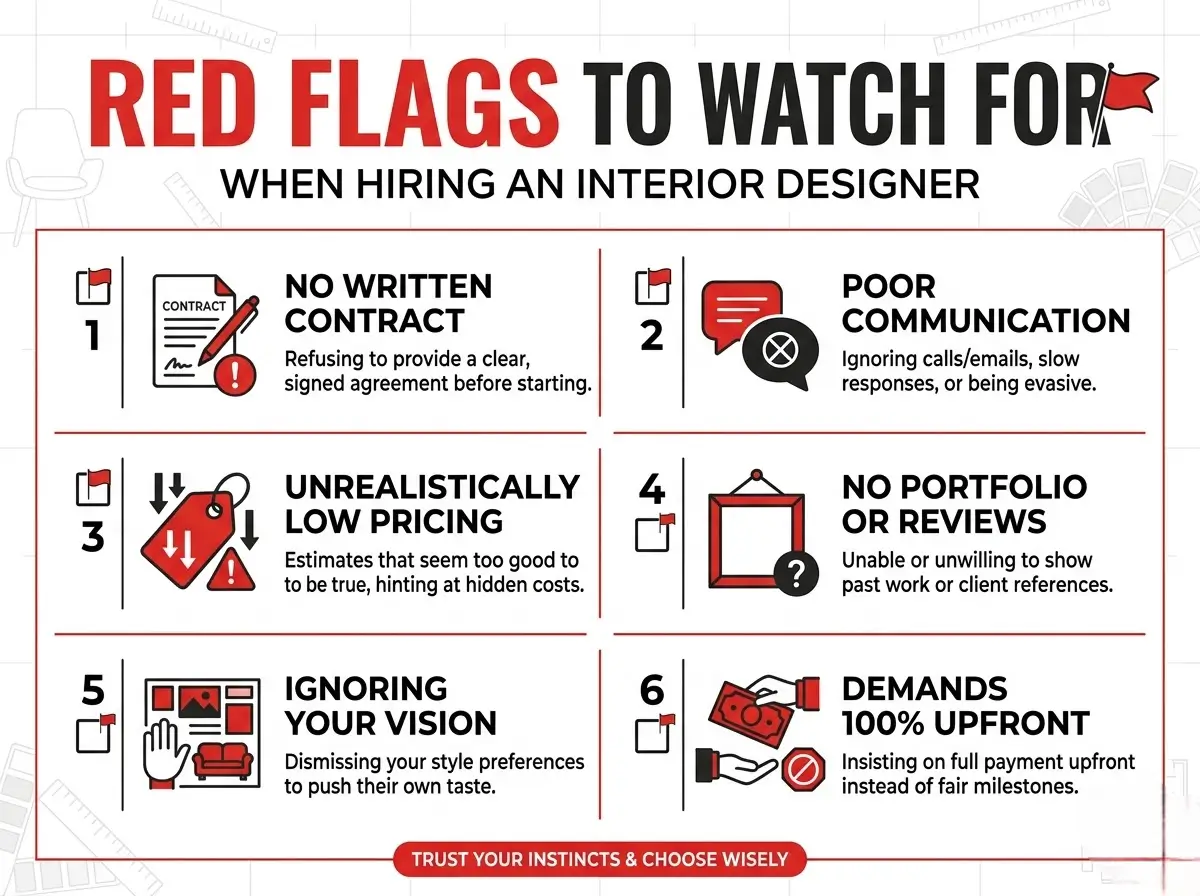
Most people searching for the best interior designers in Kenya are looking for reassurance — a shortlist they can trust. What’s just as useful, though, is knowing what to actively avoid, because a firm with a polished website and a confident sales pitch doesn’t automatically translate into a smooth, well-executed project. Here are the warning signs genuinely worth paying attention to.
The Core Red Flags
| Red Flag | Why It’s a Concern |
|---|---|
| No willingness to explain their process | Suggests either inexperience or reluctance to be held to specific standards |
| No verifiable credentials | Claims of quality with nothing to back them up externally |
| Vague or shifting cost estimates | Often leads to budget surprises mid-project |
| No portfolio relevant to your project type | A beautiful portfolio in the wrong sector doesn’t guarantee fit |
| Pressure to commit quickly | Legitimate firms don’t usually need to rush a client’s decision |
| No clear communication plan | Leads to confusion and frustration once the project is underway |

Vague Process Explanations Are a Genuine Warning Sign
A firm that can’t clearly explain its own process — how they approach space planning, material selection, or the sequence of a project — is either inexperienced or not being fully transparent. The seven layers of interior design (space planning through to accessories) represent a structured approach that a genuinely capable firm should be able to walk you through specifically, not gloss over with vague reassurances about “making it beautiful.”
Credentials That Can’t Be Verified
Claims of being “ISO certified” or “fully registered” mean little if a firm can’t or won’t provide actual verification when asked. This is a reasonable, non-confrontational question to ask directly — a legitimate firm won’t hesitate to confirm their certifications and registrations. Reluctance or vagueness here is useful information, even if everything else about the conversation feels positive.
Shifting Cost Estimates Are More Common Than They Should Be
A firm that gives a low initial estimate and then steadily adds costs as the project progresses is a familiar and frustrating pattern. While some cost evolution is normal as specific material choices are finalised, a pattern of consistently vague or shifting numbers from the outset — rather than a clear explanation of what’s included and what might change — is worth treating as a genuine warning sign rather than an acceptable quirk of the industry.
A Portfolio in the Wrong Sector Isn’t Disqualifying, But It’s a Flag
This one’s more nuanced: a firm without direct portfolio evidence in your specific project type (residential vs. commercial, or a specific sector like hospitality) isn’t automatically a bad choice, but it is a reason to ask more detailed questions about how they’d approach something outside their visible track record. R World Enterprise Ltd.’s range across residential, banking, hospitality, retail, and corporate work is one way of demonstrating breadth — but for any firm, it’s worth confirming relevant experience directly rather than assuming general skill transfers automatically.
Pressure Tactics Don’t Belong in a Design Hiring Process
A legitimate interior design firm, confident in their own standards and process, generally doesn’t need to pressure a client into a fast decision. Interior design is a significant investment, often tied to a space you’ll live in or operate from for years — a firm pushing for urgency without good reason is a pattern worth being cautious about.
Red Flags vs Reassuring Signs at a Glance
| Area | Red flag | Reassuring sign |
|---|---|---|
| Process | Can’t clearly explain how they work, or glosses over it with vague reassurances | Walks you through their process specifically for your project |
| Credentials | Claims ISO certification or registration, but won’t verify when asked | Confirms certifications and registrations without hesitation |
| Cost estimates | Consistently vague or shifting numbers from the outset | A clear explanation of what’s included and what might change |
| Portfolio | Nothing in your sector, and no detail on how they’d approach it | Relevant experience, or detailed answers on how they’d handle something new |
| Pace | Pushes for urgency without good reason | Doesn’t need to rush a decision on a significant investment |
What to Do If You Spot These Signs
None of these red flags, on their own, are necessarily disqualifying — but a pattern of several together is worth taking seriously. The reasonable response isn’t necessarily to walk away immediately, but to ask more direct, specific questions and see how the firm responds. How a company handles being asked hard questions tells you almost as much as the answers themselves.
FAQ: Red Flags When Hiring an Interior Designer
Is it a bad sign if a firm can’t explain their design process clearly?
Yes — a structured, explainable process (like the seven layers of design) is a reasonable expectation from an experienced firm. Vagueness here is worth taking seriously.
Should I ask a firm to verify their credentials directly?
Yes — this is a reasonable, non-confrontational question. A legitimate firm will confirm certifications and registrations without hesitation.
Is some cost change during a project normal, or always a red flag?
Some evolution is normal as material choices are finalised. A consistent pattern of vague or shifting estimates from the start, without clear explanation, is the actual warning sign.
Does lacking a portfolio in my specific sector automatically disqualify a firm?
Not automatically — but it’s a reason to ask more detailed questions about their approach to projects outside their visible track record.
Why is pressure to commit quickly considered a red flag?
A confident, legitimate firm generally doesn’t need to rush a client’s decision on a significant investment — pressure tactics are worth treating with caution.
The Short Version
Finding the best interior designers in Kenya means knowing what to avoid as much as what to look for — vague process explanations, unverifiable credentials, shifting cost estimates, and pressure to commit quickly are all genuine warning signs worth taking seriously. A firm confident in its standards will welcome direct questions rather than deflect them.
Ask R World Enterprise Ltd. any question directly or review our verified project portfolio.